 Danny Chepenko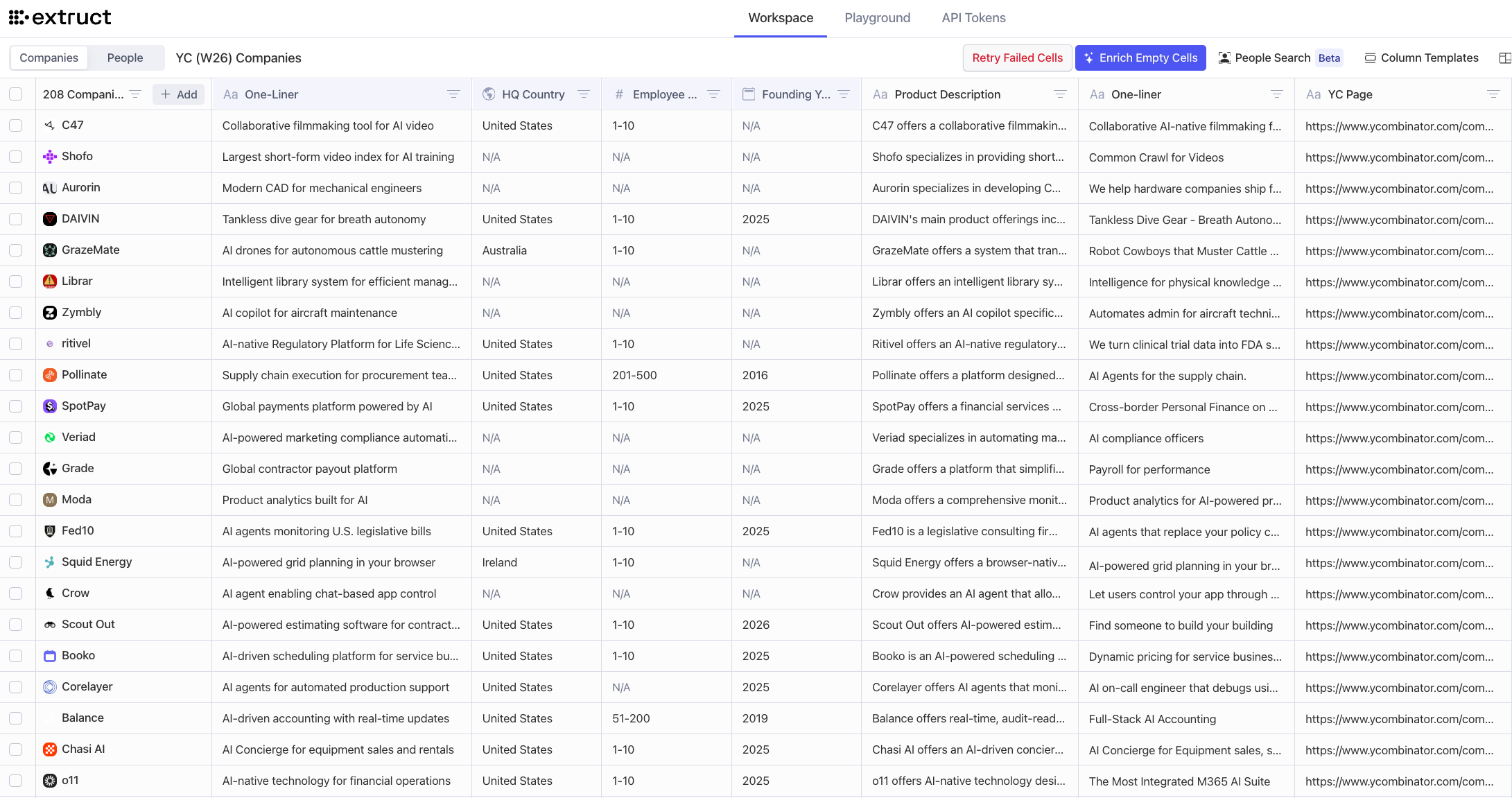
We've been covering YC batches as a quarterly snapshot of what technology makes possible. But something materially changed in W26.
Some headlines from the batch:
- 1 in 8 W26 companies is building something physical — robots, drones, wearables, space hardware, biotech
- 3X more companies in this batch reached $1M annualized revenue than W25
- 22 solo founders in the batch — 11% of W26 is one person building alone
- One company closed a Fortune 100 deal in 3 weeks
- A 22-year-old dropout is building the first hotel on the Moon and presented his Moon brick to the US Congress
- 4 companies had raised substantial funding prior to YC: Ndea ($43M), Mango Medical ($8.3M), Mantis ($7M), Beacon Health ($5.4M)
We compiled a detailed dataset mapping traction across the entire W26 batch, 199 companies with 14 data columns covering funding, KPIs, founder backgrounds, prior employers, education, and business model classification. It saves investors and founders dozens of hours of research.
YC Is Becoming More YC
There's a common criticism of YC under Garry Tan: it's not like the good old days, the partners are doing weird stuff, the batch is a B2B zoo. Nostalgia is neat. But steering one of the most important innovation institutions in the world through an AI revolution is not a trivial task.
Here's what the data actually says: YC under new leadership is returning to its historical roots. The batch is attracting younger, more technical, more pedigreed founders, working on crazier, harder-to-replicate ideas.
The average founder in W26 has 5.8 years of professional experience, down from the historical YC average of ~9 years between school and batch. And AI agent founders sit even lower at a 4.8-year median - they're younger, moving fast into the newest category.
Look at what YC actually funded this time:
LLM. There are 3 foundational LLM research companies: Ndea (43M AGI lab, co-founded by François Chollet, creator of Keras, one of the most widely used deep learning frameworks), Confluence Technologies (scored 97.9% on ARC-AGI-2, one of the leading benchmarks for measuring general intelligence in AI), and Rubric (post-training research at exabyte scale).
Hardware. 20 hardware companies are building physical things: Moon hotels, autonomous cattle drones, dive gear for space, warehouse robots, radars for self-driving.
Bio. 3 bio companies are doing real drug discovery, Ditto Bio is finding autoimmune therapies in parasitic proteins, Origin Bio built a DNA model that outperforms DeepMind's AlphaGenome, and CellType is simulating human biology from scratch.
And more. There's a company doing AI-powered uranium exploration (Terranox AI). Another one built the fastest inference engine on Apple Silicon, beating Apple's own MLX (RunAnywhere, 10.2K GitHub stars). Byteport built a file transfer protocol that is 10x faster than TCP. On unreliable connections like cellular or satellite, they're showing 1000x speedups.
That shift tells you everything about where YC thinks the puck is going - SaaSpocalypse is real. The batch is tilting hard toward deep-tech, things that are genuinely difficult to build, require real scientific expertise, and can't be replicated by a weekend hackathon with an API key.
Let's dive deeper.
What They're Building: 199 Companies, 9 Categories
We classified every company using Extruct's enrichment into categories based on what the company delivers, not just what tech it uses:
How YC Is Preparing for the SaaSpocalypse
The batch splits into two software delivery models that tell the real story:
AI-native service (56, 28%), the largest category in the batch The AI performs a job end-to-end, and the customer supervises or approves the output. Healthcare is the densest vertical within the group: Patientdesk.ai (AI front and back office for dental practices), Beacon Health (AI employees for primary care), Eos AI (autonomous OS for healthcare), ClaimGlide (automated prior-auths), Overdrive Health (AI medical billing), MochaCare (scheduling and hiring for care agencies), Scheduling Wizard (logistics infrastructure for healthcare operations), Opalite Health (language translation for providers).
Legal is the second cluster: Wayco (AI operator for medlegal cases), Arcline (startup legal with same-day turnaround), General Legal (AI law firm for growth-stage companies), Legalos (AI-powered immigration law firm), Vector Legal (full-service AI law firm for startups), Fed10 (AI agents replacing policy consultants). The rest spans industrial operations — Corvera (autonomous CPG back-office), Ventura (AI teammates for industrial distributors), Reframe (AI hardware procurement) — and vertical service replacement across recruiting (Perfectly), accounting (Balance, FullSeam), home services (Robby), hotels (Lance Live), medspas (Tepali), and security (Hex Security, agentic offensive security at scale).
AI-enhanced software (45, 22%), the traditional software model with AI embedded. Humans operate the product, AI makes them faster. The spread is wide: Caretta (real-time AI for sales calls), Cardinal (precision outbound platform), sitefire (marketing suite for the agentic web), Autumn AI (prospect research at scale), Bidflow (AI copilot for electrical estimating), Stilta (Cursor for patent attorneys), Avoice (AI workspace for architects), Foreman (keeping contractors on the job site, not behind a desk).
Energy and climate has a notable sub-cluster: Condor (energy OS for enterprise procurement), Squid Energy (AI grid planning), Inviscid AI (real-time building simulations for data centers), Terranox AI (AI-powered uranium exploration). Enterprise workflow tools round out the group: Jinba (automate workflows through chat), Cofia (AI automations that write themselves), Ressl AI (AI for ERP/CRM configuration starting with Salesforce), o11 (AI agent inside every enterprise app), Pollinate (AI agents for supply chain).
The ratio between the two delivery models is 56:45. YC is funding both sides of the fork — autonomous services and augmented software — at nearly equal weight.
Developer infrastructure (34, 17%), the builder-for-builders layer. This is the tooling that powers both AI-native services and AI-enhanced software. Agent infrastructure is the defining sub-cluster: Terminal Use (Vercel for background agents), Salus (guardrails to validate agent actions), Tensol (multi-agent orchestration), Glue (interface design canvas for AI agents), Carrot Labs (continuous learning platform for AI agents), Cascade (distilling proprietary intelligence for safe autonomous systems).
Code and dev environment tools: Sparkles (make everyone on your team an engineer), EmDash (open-source agentic development environment), Syntropy (agentic coding for complex tasks), Fission AI (plan mode for complex features), 21st Labs (AI programming tools), Haladir (formal methods in codegen RL). Monitoring and reliability: Sonarly (self-healing software), Sentrial (Datadog for agent reliability), ashr (automated multi-modal testing for agents), Canary (AI QA engineer that understands your codebase). Inference and compression: RunAnywhere (fastest on-device AI at scale, 10K+ GitHub stars), Piris Labs (Cerebras-speed inference but scalable), compresr (LLM context compression), The Token Company (compression middleware), Cumulus Labs (optimized GPU cloud).
AI research (11, 5%), this is where W26 gets weird. Three companies orbit the same AGI benchmark: ARC Prize Foundation (runs ARC-AGI), Ndea (Chollet's $43M lab — he designed ARC-AGI), and Confluence Technologies (scored 97.9% on ARC-AGI-2, essentially saturating it at $11.77/task). The benchmark, the benchmark creator, and the solver, all in one batch. Beyond that cluster: Polymath Labs (long-horizon RL), Traverse (reinforcement learning environments for long-horizon agent journeys), One Robot (world models for robot evals and training), Luel (turning everyday words into training data), Shofo (Common Crawl for videos), Human Archive (multimodal data for robotics learning). The research layer is betting the bottleneck is data and environments, not models.
Hardware (20, 10%)
Space (4) — GRU Space (first hotel on the Moon, 22-year-old solo founder, taking $250K-$1M reservations), General Astronautics (robotics for space R&D), Kyten Technologies (custom aerospace-grade battery packs), Beyond Reach Labs (solar arrays that grow to football-field size in orbit).
Robotics & drones (6) — Servo7 (robots that 10x manual industry work), GrazeMate (AI drones that herd cattle), Origami Robotics (general-purpose manipulation), Voltair (autonomous drones for Earth observation), RoboDock (robots that run depots for autonomous fleets), Remy.Ai (automating dexterous tasks in e-commerce warehouses).
Defence & sensing (3) — Milliray (technology to detect and track small drones), Seeing Systems (modular AI-commanded drones for defence), Congruent (AI-native radars for self-driving cars).
Consumer devices & wearables (3) — Fort (strength tracking wearable), Button Computer (wearable AI that can talk, 2 ex-Apple Vision Pro engineers), DAIVIN (world's first tankless dive gear for sea, land, and space).
Energy & industrial (4) — AxionOrbital Space (foundation models for 24/7 Earth observation from satellites), Voxel Energy (energy-independent data centers with solar and repurposed batteries), HLabs (US-made parts for robots), Noetic (AI that gets hardware compliance done in weeks).
Fintech (18, 9%), the third-largest vertical. The most interesting sub-cluster is building financial rails for the agent economy: Maven (payments infrastructure for voice agents), Sponge (financial infrastructure for the agent economy), Orthogonal (agentic payments for APIs). Traditional fintech is well-represented too: Panta (AI-native commercial insurance brokerage, licensed in all 50 states), Grade (API for performance-based payroll), Maywood (automating IB deal workflows), Fenrock AI (AI agents for banking back office), Kita (automating credit review for emerging-market lenders), Proximitty (autonomous business loan servicing), Sequence Markets (low-latency execution across crypto and tokenized assets).
Biotech (7, 3%), real science at the bench level. Ditto Bio (evolutionary intelligence for autoimmune disease), Origin Bio (AI and data for cancer therapeutics), CellType (simulating human biology for drug discovery), Mango Medical (foundation models for planning orthopedic surgery), Strand AI (multimodal foundation models for patient biology), 10x Science (AI-native protein characterization), ritivel (AI platform for life-sciences documentation).
Consumer (5, 2%), small but high-signal. Pax Historia (AI grand strategy game, play any moment in history) pulled 2,334 likes on its YC launch tweet, the highest of any company. Pocket (AI note-taking device, $27M ARR, 30K+ units shipped, 50% MoM growth) is the revenue outlier of the entire batch. Doomersion (doomscroll to learn languages), CodeWisp (create real games with AI), CatchBack (digital collectible card packs).
Marketplace (4, 2%) — Skillsync (hire engineers based on what they've shipped), Asimov (real-world human movement data for humanoid robots), Scout Out (find someone to build your building), Forum (the first regulated exchange to trade on attention).
Who's Building: The Founder Profile
Conventional wisdom says 2 co-founders is the optimal startup team structure. W26 confirms this, 129 companies (64%) have exactly 2 co-founders.
But the more interesting number is 22: that's how many solo founders are in the batch. 11% of W26 is one person building alone. And the domain is weird either — GRU Space (Skyler Chan, 22, building a Moon hotel), DAIVIN (Leo Kankkunen, tankless dive gear), GrazeMate (Sam Rogers, robot cowboys), Fission AI, Rhizome AI, Cumulus Labs. Fintech has zero solo founders, regulated markets apparently require a partner. Devtools has the highest solo rate at 22%.
Where they come from tells you what they're building.
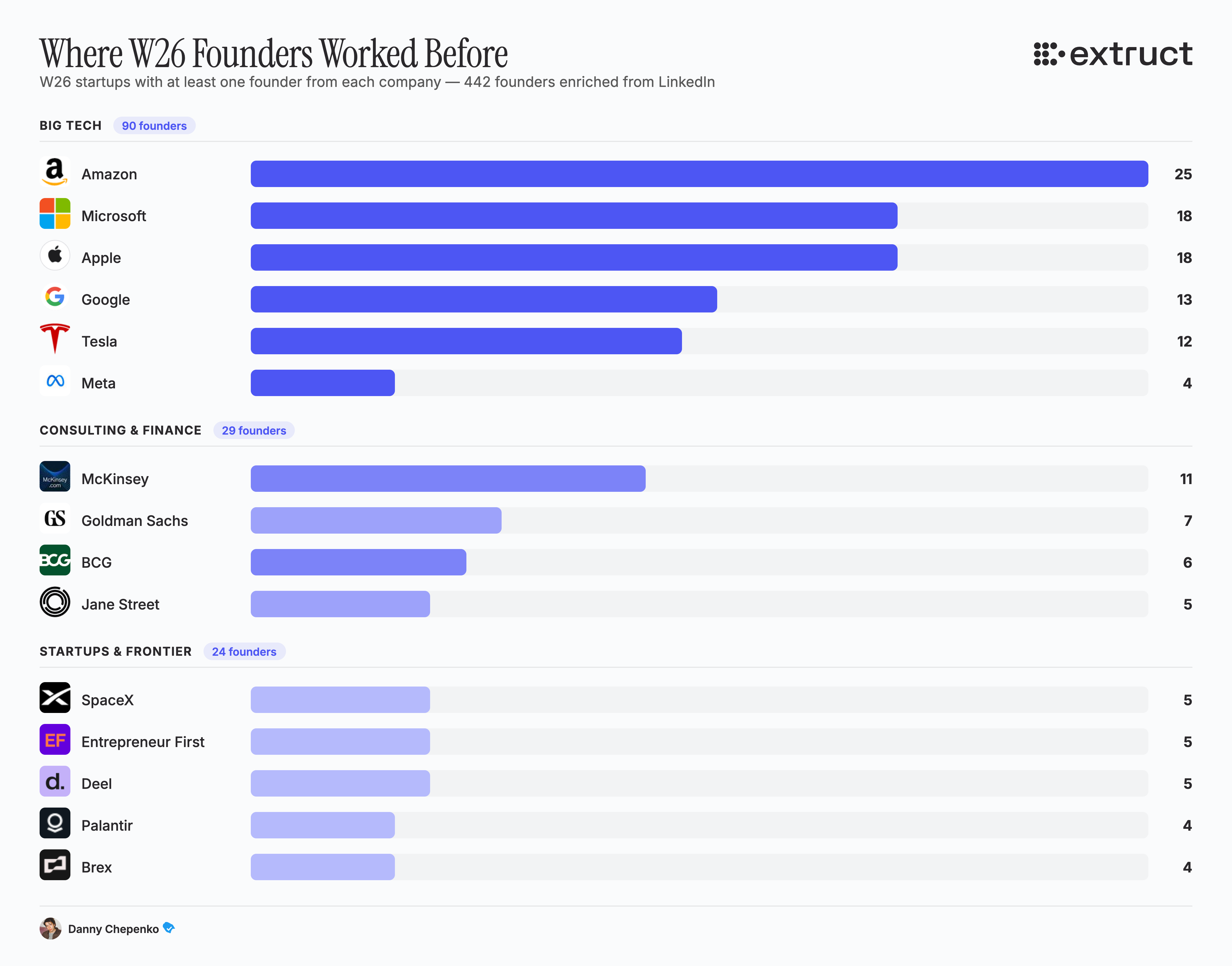
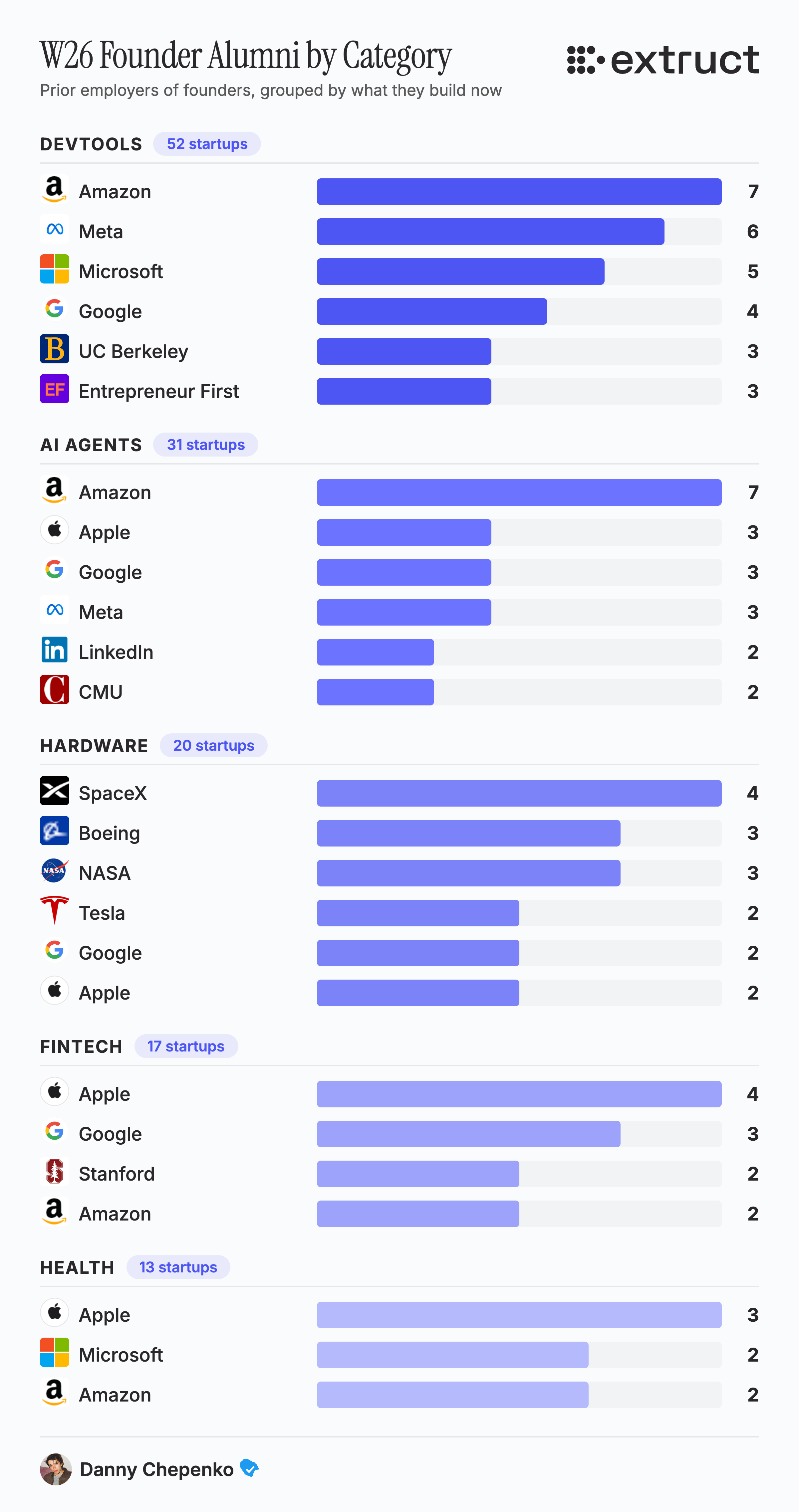
Hardware startups trace back to Tesla, SpaceX, Apple, the companies where founders learned to ship atoms. Button Computer's founders built Apple Vision Pro. Fintech is an Apple-and-Google story. AI infra has 2 startups with NASA alumni, the research layer draws from unusual places. AI agent companies lean Amazon and Meta, plus consulting (McKinsey).
Overall, Amazon is the #1 feeder: 14 W26 startups have at least one ex-Amazonian. Apple is second at 12.
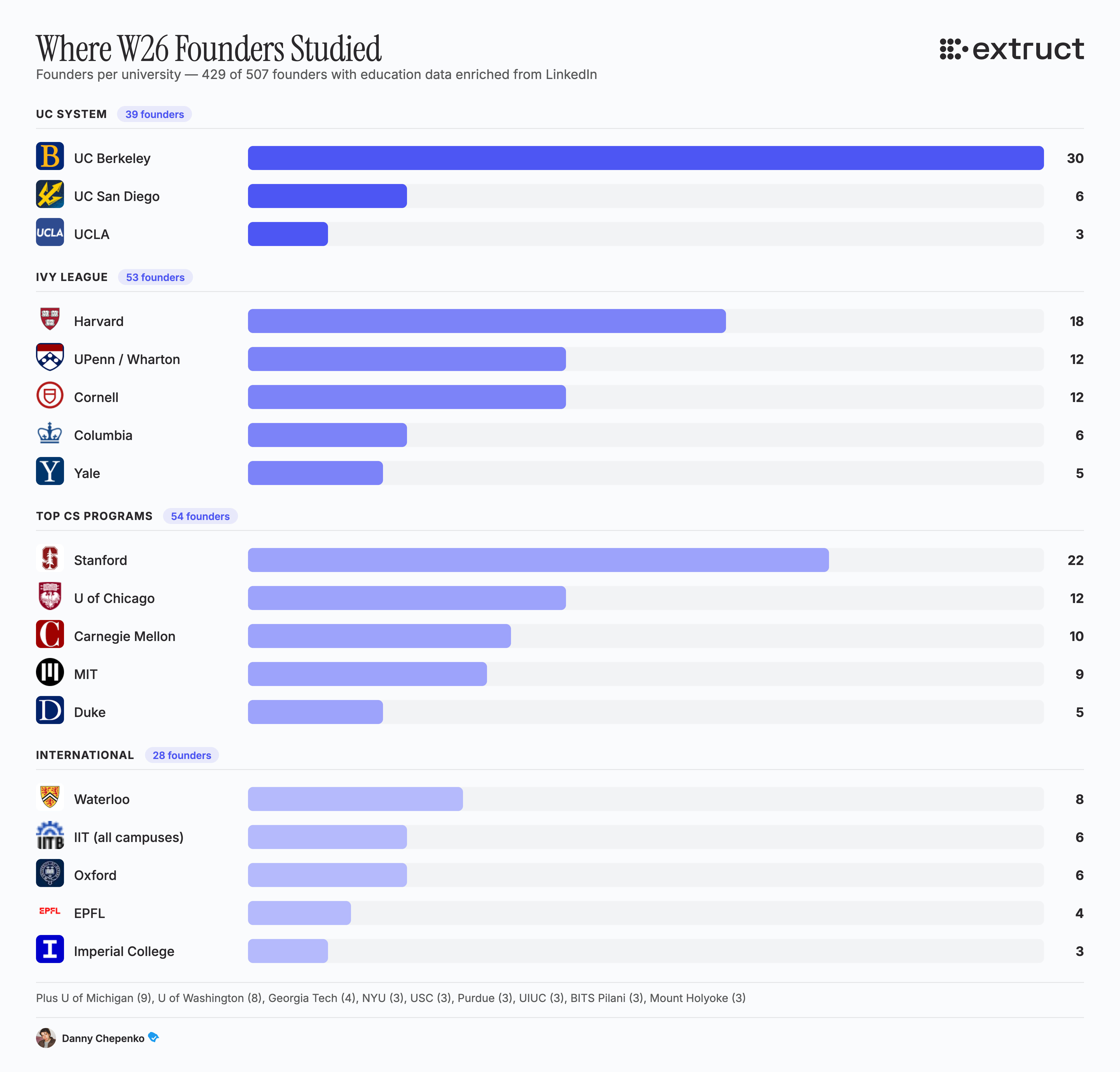
The university pipeline: Berkeley dominates with 30 founders, nearly 1.5x Stanford (22). Harvard is third at 18. The top 3 account for 70 founders, ~16% of the batch.
Geography: San Francisco is the center of gravity. Again. 69 companies are headquartered in SF proper. Add the broader Bay Area (Berkeley, Palo Alto, San Mateo, Sunnyvale) and California accounts for 78 out of 117 companies with location data, 67%. New York is a distant second at 9. The batch is heavily concentrated.
The non-US cohort skews toward deep domain problems, energy, defence, healthcare, and industrial robotics. Worth noting: no startups from emerging markets. Outside the core EU hubs (London, Munich, Amsterdam), the only surprises are Copenhagen and Sydney.
Top Launches by Twitter Engagement
YC launch tweets are the first public signal of which companies resonate. High engagement doesn't guarantee success, but it shows what captures attention from founders, investors, and engineers who follow. It's also a leading indicator of which companies will have an easier time with distribution post-Demo Day.
What the crowd responded to, ranked by likes on @ycombinator launch tweets:
- Pax Historia (2,334 likes) — AI sandbox game where you can play any moment in history
- RunAnywhere (2,167) — 10K+ GitHub stars, fastest Apple Silicon inference
- Pocket (2,076) — $27M ARR, 30K+ units, 50% MoM growth
- Skillsync (1,854) — hire devs by GitHub, not resumes
- Cardboard (1,480) — agentic video editor, hit revenue goal in 4 hours
- Fort (1,295) — strength training wearable
- GrazeMate (1,210) — autonomous cattle drones
- Compresr (1,150) — Claude Code integration, context compression
- GRU Space (1,098) — Moon hotel, 22yo solo founder
Hardware and "weird" companies dominate. 4 of the top 9 build physical things.
The Bottom Line
YC W26 is the deepest-tech batch in recent memory. The SaaSpocalypse talk is reflected in what YC actually funded. Hardware is back. Foundational AI research is in. Healthcare is defined. The founders are younger but more technical, coming from Tesla and SpaceX instead of consulting firms, building things that are genuinely hard to replicate.